Sunday, January 29, 2012

Educon 2.4 Reflections 2012

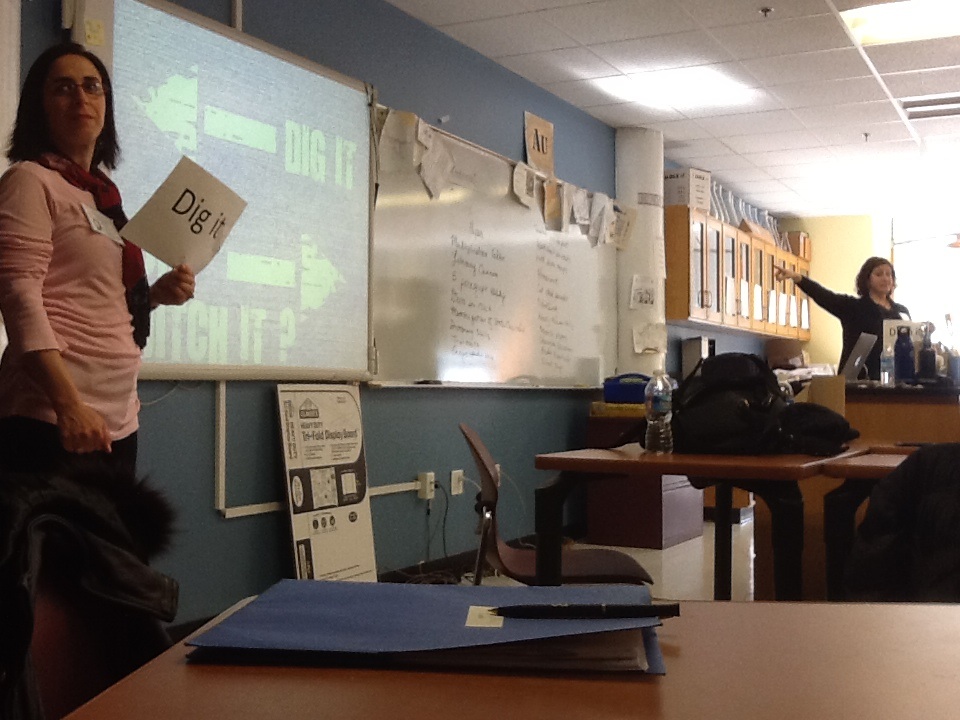
Lisa & Liz Presenting at Educon 2.4
There is always so much to think about on the way home from Educon. And this year was no different. As I sit home unraveling my experience, I am feeling a mix of emotions. As always it was wonderful to see my old Educon friends and meet many new ones. I attended some interesting sessions, presented an Encienda (20 slides, 15 seconds per slide), and presented a session with Lisa Thumann.

Here are some of my take-aways.

Boy is this a heady experience! Educon lives in the brain. It is a conference of ideas and ideas and ideas. Each session tries to think positively about ways we can improve our educational system. When I leave the conference I often feel my head is going to explode. The next step is to take all of these swirling pieces of something in my brain and put them together to create an actionable step in my professional life. That is the biggest challenge.

Boy do I dislike panels. I finally came to the realization that I just don't like panels. It isn't the panelists, it isn't the setting, it isn't the topic, it is the structure itself. First of all, I'm not afraid to admit I have a short attention span. Listening to people talk, without being able to interact with them, is not my favorite type of learning. I can stand a lecture if it is well crafted with a story to tell and an interesting message. The problem with panels (for me) is that the topics jump all over the place. I often feel like the panelists are just vying to get their voices heard (as opposed to having something to say). There are occasionally bits of genius mixed in, but I find it hard to pay attention enough to catch them. This year I watched the Friday night panel in the overflow room (next year I might watch from Mace's crossing ;-). If I follow the Tweets, I might glean more than if I were in the room.

Boy does the Educon crowd use social media well. The aggregation of information through a single hashtag is brilliant. I know I can look back and learn from the sessions I couldn't attend. This level of comfort brings the technology the closest to "oxygen" than any conference I've been to.

Boy are there a lot of good teachers at Educon. Half of what I learn by attending sessions are pedagogical teaching methods and protocols that I can try in my classrooms. I don't just come away with ideas, I come away with methodologies that I can use to support learning (regardless of the content) with my students.

Boy have I heard a lot of this stuff before. I can't deny I'm getting a little jaded. Each year we talk about the same ideas - giving students more choice, students as teachers, problem based learning, innovation, 21st century learning, higher level thinking, blah blah blah blah blah.

Using the What if, and, and, and protocol introduced to me by David Jakes, What if Educon did the talking and the walking, and each one of us left with one concrete action that we could bring back to our schools, and we made a connection with one other person who promised to support us in that endeavor, and we publicly shared our progress on completing that action, and we came back each year and built on that action until all the little pieces made a big change? Wouldn't that be cool!

Sunday, January 22, 2012

5 Things I Love about Educon

At my first Educon 2008
This will be my fifth Educon, and over time, my relationship with this conference has changed, from the freshman excitement of meeting everyone for the first time at Educon 2.0, to the highly anticipated sophomore year, when I couldn't wait to go back and see everyone, to my junior year, where the the familiarity of a place I know well led me to give some Educon advice, and finally my last year as a senior attendee I shared a bit of my disillusionment. And even though I should perhaps have graduated, I'm still committed to this extraordinary conference.

Here are a few reasons I keep going back.

1. The People - For this reason alone I would keep going back. My Twitter network came alive at my first Educon and now it feels like a reunion every time I go back. There are people there I only see once or twice a year, with whom I have developed strong relationships. Every year I add more people to the list. 


2. The Conversations - I can always count on having interesting conversations with people who are facing the same issues I am at their schools. In so many places I am ahead of the pack, doing things others have yet to try.  Not so at Educon, where I can always find someone who is far ahead of me. I learn so much from those folks. 


3. The SLA students - I am always impressed and inspired by the kids who help run this conference. They are an example to me of what students can accomplish if they are given the responsibility, trust and inspiration that The Science Leadership Academy provides for them.


4. The Challenge - Challenge comes in many forms at Educon, there are people who challenge your beliefs and ask tough questions. There are events that require meeting people you don't know (which can be scary at times). And this year I am challenging myself to do an Encienda Educon presentation, something I have never done before.


5. The Sessions - I guess it is ironic that the actual sessions are last on my list. I certainly have not forgotten them. I always enjoy both presenting and attending sessions with this community. There are som many great sessions to choose from, it can be difficult to choose one.

Liz and Lisa
And then there are the purely personal reasons. Hanging out with people I have grown to love, driving 3 blocks down the road when we should be walking, laughing at Chris Craft as he freezes his South Carolina tush off, following around "my conference wife" Lisa Thumann, eating some delicious Philly steak, catching up with Joyce Valenza, David Jakes, Alec Couros and so many more I can't name them all here.

I can't believe it is less than a week away. See y'all there!

Tuesday, January 17, 2012

My iPad Adventure

First semester has just ended and I am finally taking a breath and a moment to blog. I know it has been forever. I've been in the thick of teaching 7th grade English and setting up an iPad pilot for our school. Both have been extremely time consuming.  In this post, I'll focus on my iPad adventure and save my 7th grade English stories for another day.

The Plan:
We purchased 30 iPads this fall and have disseminated them to one faculty member in each department. In addition, we will be piloting 2 iPad classes starting in the second semester (next week). We have chosen a geometry class and an art history class for our pilots, primarily because those teachers volunteered to give it a go (and their class sizes worked with our numbers).

Figuring out the set up process and actually setting up the iPads has taken an enormous amount of time. We are using the Apple Store Volume Purchasing Program to pay for our Apps. In order for the school to own the Apps, I had to create separate Apple IDs for each of our faculty members and students. I also had to set up email addresses for each Apple ID and separate email addresses/Apple IDs for the VPP program. Getting my head around all of the steps in this process was exhausting. I think I have finally figured it out.

We also had to work out an iPad agreement and an iPad insurance plan for parents and students. Thanks to all of you who sent me prototypes. I used a little bit of everyone's agreements. Thanks especially to Patrick Larkin, principal of Burlington High School and to Scott Reisinger, headmaster of Bancroft School who have helped clear the path to make this easier for the rest of us.

My Progress
At this point all of piloting faculty members have received their iPads (right before winter break). I have met with them as a group once to show them how to purchase Apps. I am planning to meet with each of them one-on-one in the next two weeks and we are meeting as a group at the end of the month. I have to finish setting up student iPads this week and will hand them out next week at the start of the new semester.

The Future
It is hard to budget for a future iPad program when you aren't sure you really want one. The difficulty is that this is all based on the success of the program. It may be that we don't think iPads are right for us or there may be some newer technology that we think is even better.  At this point I'm taking this journey one step at a time. I can't quite see the end of the road, but I'm confident each step will bring me closer.

Have you tried piloting iPads? Do you have any wisdom to share? Are you thinking of trying out your own pilot? I welcome your comments, questions, and suggestion!

Saturday, November 19, 2011

5 Things I hate about the Kindle Fire

I was ready to love it. I put my name on the list the day it was announced. I waited and waited. When it finally shipped, I tracked that shipment like a hawk. Then it arrived.

My school has recently decided to do an iPad pilot. We are deploying 30 iPads and budgeting for more next year. I thought the Kindle fire might just be a cheaper alternative. Well it's not and this is why.

1. Boy is it heavy! It is supposedly lighter than an iPad, but if you held one in each hand you wouldn't think so. It is shaped like a brick and feels like one too. I tried reading a book on it and my arms felt like falling off.

2. The App store is lame. I admit I am not used to an android device, but I looked for several apps that I use on my iPhone and my iPad and couldn't find them in the Kindle App store.

3. No fetch feature. There doesn't seem to be a way for the Fire to let you know when you have new mail or it is your turn to update your Words With Friends. You have to manually check for all updates. I also can't figure out how to add multiple e-mail accounts to the mail feature. Maybe that is just me being obtuse, but I have looked everywhere for a way to add an additional account.

4. Not so fast. I haven't noticed that the new "silk" browser is particularly fast. Supposedly it is super speedy. It isn't slow, but it doesn't seem much faster than my phone (and I have an iPhone 3GS).

5. It is neither here nor there. It is a smaller heavier feeling iPad and a bigger much heavier iPhone and an eReader with a lot of glare. If I want to type something, or check out some cool Apps, I'll use the iPad. If I want something small to check in on my email, my Twitter feed and my Words with Friends I will use my phone. If I want to read a book, I will use a traditional Kindle. I haven't figured out when or where I would use the Fire.

OK. I know I am privileged to have so many devices to choose from. I know it is a cheaper alternative to the iPad. I know the video streaming is cool. It just doesn't do it for me. And did I mention is is heavy like a brick?

I wanted to like it. I really did. It just doesn't live up. Do you have one? Do you agree? I'm interested in your opinion. Please let me know what you think.

P.S. My fall has been crazy at school so I haven't been blogging, but I have lots of things to share - some cool video projects and some iPad deployment advice, so stay tuned.

Monday, October 24, 2011

Marching Backward into the Future

“We look at the present through a rear-view mirror. We march backwards into the future.” 
http://www.flickr.com/photos/derbaum/14504516/
- The Media is the Massage. An Inventory of Effects. McLuhan & Fiore. p74

Everything we look at is shaped by our experiences. We come from a 20th century perspective and it is incredibly difficult to imagine what the 21st century will bring. When I started teaching 20 years ago, could I have envisioned an iPod, a netbook, a Kindle? We had the beginnings of an Internet, but nothing like the global interactions of today. And yet it was my job to prepare those 6th graders for their future.

Those 6th graders are now about 32 years old. Do we feel the 32 year olds of today are not productive? Are they not capable of doing the jobs we need them to do? If I taught them to think and to write and to question and to explore, did I not prepare them for their future?

And what of my students of today? How are they prepared to meet their destiny? We live in this moment and our vision is shaped by what came before us. We can imagine what will be next, but all of of our imaginings are seen through the lens of our own histories. And each of us brings a different history to our predictions.

In the field of education there is much anxiety about the future. These anxieties are only compounded by the downturn in our economy. Is this because we didn’t prepare our students for what was to come? How can we make sure that our country will be led by a knowledgeable and capable workforce? Is technology the answer?

How do the innovators of today come up with these inventions? Where do they get the ideas that transform our world? Someone invented the iPod, the Kindle, the iPad. Where did they go to school? Who were their teachers? Did they march backward into the future or were they somehow turned around?

Sunday, September 4, 2011

New York Times edtech article fails the test!

The front page of today's New York Times boasted an article about the "failure" of technology in the classroom. Titled, In Classroom of the Future, Stagnant Scores , the article describes a school in Arizona where, despite a huge investment in technology, there hasn't been an increase in test scores.

The article is based on one school in one town in Arizona, hardly a statistically significant sample. Larry Cuban, an outspoken critic of technology in schools since the early 1990s, is quoted multiple times. Not one of the many experts in the field of educational technology, whom we know and love, was interviewed (or at least quoted) in the article. The only reason given for the failure of technology is a lack of increase in test scores in a district that already had high test scores. Finally, there was no test comparing the technology skills of students in this school to any other school in the state.

Clearly, I'm not thrilled with the article.
What did you think?

Sunday, August 28, 2011

The Plus One Challenge!

This summer my entire faculty read the book Switch: How to Change Things When Change is Hard by Chip and Dan Heath. The book lays out some clear ideas for how to make change in an organization. The authors use a metaphor of an elephant, suggesting there are three things you need to do to affect behavior:
  1. Direct the rider: Be very clear about what you want people to do, make it as simple and concrete as possible.
  2. Motivate the elephant: Appeal to the heartstrings and the emotions. Give vivid examples of why people need to change.
  3. Shape the path: Make it as easy as possible for people to complete the challenge. Figure out what is getting in the way and try to remove obstacles.

On Friday I presented the "Plus One Challenge: to my faculty:
  1. Direct the rider: Add one technology project to your repertoire this year.  If you do zero right now, do one, if you do two, do three etc. It could be anything. You could do the same thing twice. Just add one.
  2. Motivate the elephant:  We need to keep up with our peer schools. We can't be left behind. 
  3. Shape the path: I will make this as easy for you as possible. I will meet with every member of the faculty by the end of the first semester to see what you are doing and how I can help.
So there you have it. I'm excited to start a new year and see what happens. I hope it works!


The Elephant and the Rider

Image Soure: http://www.flickr.com/photos/xverges/5276822875/